
GOA CARNIVAL
Goa Carnival
Churches in Goa:
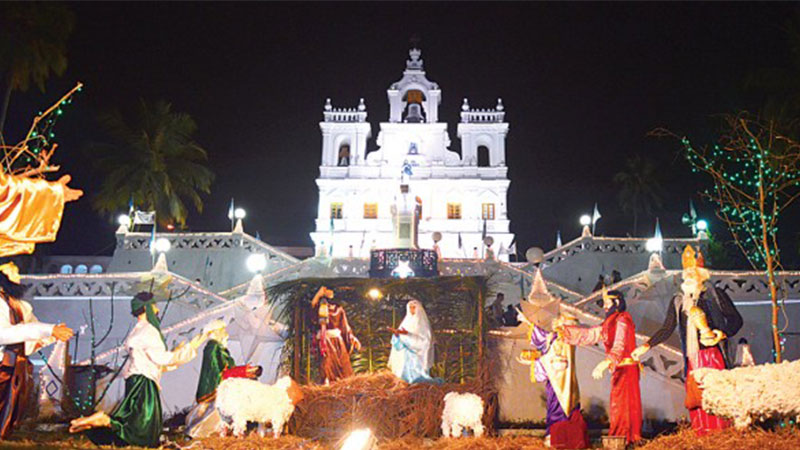
Although introduced by the Portuguese who ruled this territory for over 50 years, from 1510 to 1961, the three-day festival primarily celebrated by Christians, has absorbed Hindu tradition-bound revelry and western dance forms, and stimulated by the artistry of the Goan genius turned into a pageantry of singular effervescence.
Among the various colourful feasts and festivals feasts and festivals that Goa celebrates -with great eclat, Carnaval and Shigmo are the most rumbustious, awaited by the population with intense enthusiasm. Unlike 'Shigmo' which is also celebrated in some oilier parts of India, although under different appellations, 'Carnaval Goa's own, unique, and the Union Territorys contribution to India's other expressions at untrammelled revelry.
If down the centuries Carnaval was enjoyed only by the local population, today its fame has crossed the frontiers attracting thousands of people from all over India to whom this type of extravaganza is at once riotous and different.
The participation of the Goa Government and the Municipal Councils in it and the post-liberation introduction of the King Memo and his colourful procession have endowed Carnaval with a new dimenion and it is bound to attract more people every year to this territory whose scenic beauty and white-sanded benches have already earned Goa high praise.
It was in the fitness of things that the Goa Government, through its Department of Tourism, should have given a boost to the celebration of the three-day Carnival festival as a major tourist attraction. Distinctly Latin in character, a legacy of Portuguese cultural tradition, the Carnival is not celebrated elsewhere in hidhi, and it wan in decline even in Goa in the last years of Portuguese rule. Its revival and celebration with an added zest was, therefore, on the cards as, after Goa's Liberation, tourism was being developed as a regular industry. This festival of three days of gay abandon, riotous revelry and merry-making now attracts to Goa thousands of tourists from all over India.
The word Carnival (Carnaval in Portuguese) is supposed to be derived from flu- Latin Carnelevarium or rarnem levarem, meaning "to take away meat", which actually happens at the commencement of the 40-day penitential period of fasting in commemoration of Jesus Christ's fasting in the wilderness, known among the Christians as Lent, during which abstinence from meat is a rule. The Konknni world venture, by which it is known among the illiterate masses, comes from the Portuguese intrude, in turn coming from the Latin Latin Introitum, meaning entry into the Lenten period.
Celebrated particularly in the Latin Catholic countries of Southern Europe, it appears to have originated in Italy as a substitute for the Roman pagan festival known as Saturnalia in honour of Saturn, the god of Agriculture, observed in the month of December as a period of unrestrained merry-making, as it signaled the rebirth of Mother-Nature and the beginning of a New Year. From Italy, in which country it was celebrated with éclat mainly in Rome, Venice, Florence, Naples and Turin, it spread out to other Latin countries such as France, Spain and Portugal and also to Germany and Austria. The Portuguese brought it to Goa as they also took it to Brazil. Where it is celebrated with undiminished gusto even to this day, as it is in Argentina and other Latin-American countries, where it was imported by the Spaniards, while it almost died away in Europe, except for a few places, like Nice, among others.
Brutal and city in days gone by, in Goa as in Portugal, with real street battles fought by groups of masked people armed with baskets of rotten eggs and saw-dust or wheat flour packets known as cartuchos and cocotex and syringes filled with coloured water, so much so that that there were from time to time ediets in order to curb its excesses, the Carnival festival gradually became more moderate, being of late confined to the halls of clubs and other recreation centres with balls, fancy dress parades and such other innocent passtimes.

Enquiry Form

Stay updated
Subscribe to our newsletter to get early notifications of our great offers and promotions!